A man who wanted to expand knowledge of new advances in learning and was a patron of the arts, also the mastermind behind the building of the Acropolis, wanted nothing but power and wealth for his beloved city of Athens. While glorifying the city, he, unknowingly, was also setting it on a course of death and despair. Pericles was born around 493 BC to a rich aristocratic family. There is little known about his early childhood, due to the events that took place during it. When he was three years old, the Persians had their first attempt at conquering Greece, but were defeated at Marathon. When Pericles was thirteen, they tried again, at this time he was probably evacuated with other women and children. In 472 BC, Pericles sponsored a major dramatic production for the festival of Dionysus. Besides being entertainment for the city, the festival allowed sponsors to get their names out in the public. He was assigned the play called 'The Persians' which was written by Aeschylus, the first of the great tragic playwrights. The play won first place and Pericles, being the sponsor, also won public prominence. At this time, Pericles was married to his wife. Being in Ancient Greece, Pericles didn't even know the name of his wife, who he had two sons with. Pericles first encounter with politics happened in 461 BC. He teamed up with Ephialtes, a politician, and organized a vote in the popular assembly that deprived the Areopagus, the old noble council, of its powers. Many historians believe this marked the beginning of Athenian democracy. With the Areopagus not having power there was a stir in the city and Ephialtes was assassinated. The current rising leader at the time was Cimon. He tried to make himself Athen's foremost politician, but was ostracized by the common people. This opened up a spot for Pericles to join the reigning top politicians. In his first ten years, Pericles had important military expeditions, reinforced Athen's s control over the naval alliance called the Delian League, he approved final peace with Persian and introduced payment for jury service. This helped the poor become more involved in politics, because they were able to take time off of work. In 451 BC Pericles divorced his wife and started living with Aspasia. They were not married and Pericles saw her as an equal, which was uncommon for Greek men. 447 BC marked the start of the building of the Acropolis, which was easily Pericles biggest success. The Acropolis was meant to show Athen's wealth and power over the rest of Greece. It cost 5000 talents which is equivalent to $3 billion today. It took 15 years to construct the building. It was made out of 20 thousand tons that were quarried from nearby Mount Pentelicus. Pericles brought new authority and stability to Athenian politics, it was a unique moment in Western history. He was tutored by Anaxagoras, and he became a patron and supporter of the arts and new advances in learning. With this, Athens became the school of Greece. Other parts of Greece were not happy about Athens rise of power. Sparta was one, becoming suspicious of the naval power and rumor of war started. In 431 BC Pericles urged war stating 'If we go to war, as I think we must, be determined that we are not going to climb down. For it is from the greatest dangers that the glories are to be won.' The popular assembly then declared war on Sparta. Pericles insisted that Athens retreat to the safety of the cities walls and have the navy supply them, at all needs to avoid land battle with Sparta. The Athenians thought that they were invincible, but soon were proved wrong. In 430 BC Athens was struck by a plague brought over from the very boats that were serving as their lifelines. Often, those struck with the fever would jump into the water to cool off, contaminating it and causing more people to be infected. There was an estimated 100,000 people inside the walls of Athens before the plague and after it had worn itself out, around 20,000 had died. Pericles was one of the unlucky to become ill. The city surrendered to Sparta and then turned on Pericles, they saw him as the one to blame, not just for war but the plague, too. They stripped him of his office and fined him. In 429 BC, weakened by plague, Pericles, the mastermind of Athenian glory, died. |
||
 Pericles in front of the Acropolis |
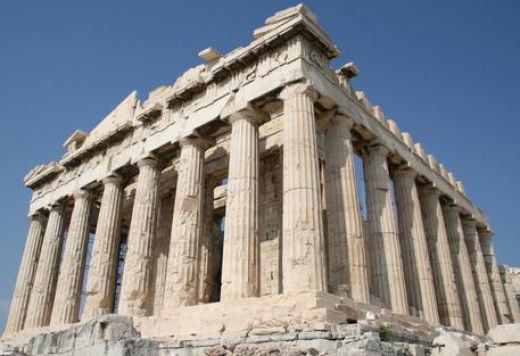 The Acropolis |
|
